Showing posts with label Africa. Show all posts

Jan 21, 2013

My Backyard: A Sight to See


When one hears Somalia he/she would expect to read about the negative light that had buried the country’s diverse rich history and existence. Use any search engine and the first thing that pops up about Somalia is piracy, Famine, failed state, corruption, armed civilians e.t.c. Every article I read starts with something like ‘Somalia has been suffering of a failed state, war torn, plagued by war lords, famine ...’

In school, when governance is mentioned Somalia is always referred to as the ‘how not to’. There was nothing but negativity being reported, no one or few were reporting the rich cultural history of it, or how Somalia is a nation of poets, or how generosity and resiliency is embedded in the social fabric of Somalis. 

As part of the Somali Diaspora, I grew up thinking that I didn’t owe allegiance to my homeland because I truly believed what was shown to me in the media and social outlets. It felt like a brain wash, an attack on Somali Diasporas to believe that we can never claim Somalia as our own and that we should be grateful not to be there, almost forgetting what our backyard is like. 

While residing in the US I felt out of place in a sense because here I was in a country I couldn’t claim as my homeland (birth place) yet the place I call home I couldn’t go back to. Not that I am saying America didn’t welcome me or provide me with great opportunities, it’s just that home is where the heart is and I was longing for my first home. My parents and relatives were always over excited when they talked about Somalia but here I was feeling lost and thinking: are they crazy? that Somalia couldn’t have existed. I was forced to put on a mask of disguise, never express my longing to feel the warm deep red soil between the fingers of my feet and the eagerness to swim in the clear blue waters with an all year round warm weather, or enjoy the mangos and bananas we are so famous for, or wear my ‘bati’ (which I think is pretty liberating by the way cause you don’t have to worry about what you are going to wear that day and how you are going to style your hair) amongst many other things.

On November, 2012 I decided I wanted to take a leap of life and go to Somalia. What could I lose at this point? death is going to come wherever I am anyways. It could have been on the 395 highway in VA, the orange metro line in DC, or worse I could have been standing right outside my house in Fairfax and simply just drop dead. So why was I so afraid to go to my birth place if death is everywhere?  After twenty one years of living in the ‘qurbaha’ (abroad) which felt like an eternity, I got on a plane and I knew where my destination was, Somalia. 

Let me tell you my friends, the flight from Kenya to Somalia was pretty scary. It was a small 8-10 passenger plane, and it rocked like a baby’s crib in the air. For a minute I thought this is it, you came and found death. So I started reading ayatul Kursi (a verse from the Qur’an) over and over, and I just don’t know when and how I fell asleep in a rocking plane.

After four hours I landed in Bosaso, Somalia. You may know it as the ‘land of the pirates’ but I knew I was in a land where there were free coast guards, guarding what is their God given right. My God, the view of the ocean from the plane was breath taking, to die for. After the plane safely landed, the door opened and I was embraced with a fresh warm air which smelled like the ocean breeze. Almost missed a step while trying to chase that ocean smell with my nose, fortunately the young man with the warm welcoming smile standing by the steps caught my arm and said ‘ku soo dhawow Bosaso walaal’, welcome to Bosaso. I reached down for the earth, grabbed a handful of soil rubbed it between my hands and felt a sense of calmness and peace within. 

Home sweet home, I was in a euphoric state of mind.

I stayed in Bosaso for a few days, my first impression didn’t match up to the perception I had, it was better than expected. Although the planning of the city was pretty poor and old, it was distinctive; it spoke to you in a way. There was a mix of new and elaborate houses that represented hope of the future and old run down houses that sort of reminds you of the past. The market was lively; the chaotic traffic was like a jingle unique to this place. It is filled with everything and anything you can think of. I saw things that one would need to special order in the US, here you could easily walk into a store and grab it that same day. The port was right there, everything came in abundance. I used to hear people tell me Somalis are business minded by nature but to see them in action was priceless. I didn’t see an army of pirates like everyone thinks, I saw ordinary folks going about their business and living. 

These people are happier than you and I, they are content, life here is viewed as a gift not a right. There was something humbling about this that gave me butterflies in my stomach.

My next destination was Badhan in the Sanaag region, the road to Badhan was pretty rough, but the presence of the nature was loud and raw, pleasing to the eye. I just couldn’t get enough of it. There was something so beautiful and magnificent about an under developed and untouched land. Herds of camel and other livestock in hundreds grazing everywhere with young men ‘geel jire’ (nomad) chasing them around to keep them in the flock. Let me not forget about the striking hills that surrounded everywhere, great for hiking and family picnics. I was told here in some of these hills were salt, luban, and marble stones amongst many other natural resources. I’ll admit it was a pretty rocky and rough road that sometimes wouldn’t let you stay still in your seat; I was bouncing up and down, definitely nothing I was used to. I guess it’s true when they say to experience personal growth one needs to get out of their comfort zone, that I did indeed. The weather there was sort of nippy, people had their own personal gardens of fresh fruits and other vegetables in their houses. Kids in all ages playing soccer, chasing goats around and the elderly sitting outside with a cup of tea laughing from the top of their lungs was a sight to see. Badhan is the perfect location when you want to get away from the city life and enjoy nature at it’s true state.

So far I have visited the regions of Bari, Nugal, Sool, Sanaag, Mudug and hope to visit plenty more working my way down South. Mogadishu is definitely on my bucket list, hopefully visit the hospital I was born in and the streets I played in as a kid and try to imagine the Somalia my parents always told me about.

I tell you my friends Somalia is well alive, it’s not dead, claim it, own it, don’t hunch back your shoulders, put up your head up and be proud to be a Somali. The language is so rich, the traditions are rare, the land is prosperous and the people are resilient. Interesting journeys make interesting people and it all starts with a single step. It may not amount to glitz and glam some of us are used to but it’s glamorous in it’s own way.It is definitely a sight to see!

Jan 5, 2013

A New Dawn

The beginning of a new year is always promising and full of hope. We spent much of December and beginning of January planning the dreams and aspirations we hope to achieve in the new year. I for one had a very fulfilling 2012 and so my only real goal for 2013 is to try and stay on course.

I was very lucky to have been able to travel to Somalia last year and play a small part in the political changes the country was going through as well as help highlight some of the developmental challenges that still plague many regions. One of the main issues that weighed heavy on my heart, and that I wish to focus on in this brief note, is the haphazardness in the way many people were operating and this is largely due to people meddling in areas that are outside their skill-sets. It sounds very elementary but chaos certainly rises from people trying to do jobs they are not equipped to do. And this is across the board from politics to media, education and humanitarianism, I saw people young and old with lots of enthusiasm and zeal but zero clue of what ought to be done. I sadly also noticed how many people are in it for the wrong reasons, seeking praise and recognition without putting in the hard work. This is an underestimated and overlooked issue that can be costly if it is not addressed.

That being said, I remain inspired by the few that are the exception to the above issue, especially the youth both from the diaspora and within Somalia that put their degrees and professional experience to good use in places where they are really needed. It's these kinds of efforts that need to be sought out, empowered and promoted. The youth really can make the necessary change, if equipped with the right guidance and support as their hearts are often clean from the traumas of clannism.

This is the time where the older generation needs to put their differences aside and come together to inspire the next generation of leaders and in order for that to come to fruition, older generation need to start reflecting on the kind of influence they have on their youngsters and whether this can bring positive changes in the long run.
More than anything,sincerity and a revival of moral conscientiousness needs to take place among all that wish to work towards the rebuilding of Somalia.
May this year be the year she starts to shine.....

Nov 3, 2012

Uganda's threat shows the fragility of peace in Southern Somalia


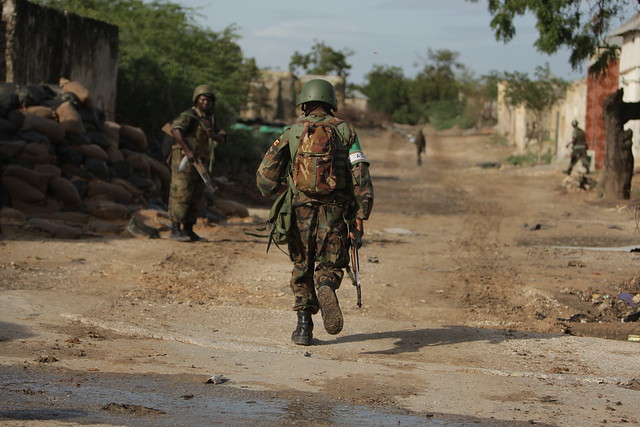
Ugandan soldiers in Mogadishu from AU/UN flickr

There has been relative peace in Mogadishu and other areas previously controlled by Al-Shabab. However, this peace is not due to the efforts of the Somali people but rather enforced by the presence of the African Union Mission in Somalia (AMISOM), primarily comprised of Ugandan troops.

Uganda now threatens to withdraw its troops from Somalia due to a UN report detailing its role in arming and supporting rebels in the Democratic Republic of Congo.

This threat worries the Somali government, which entirely relies on the AU peacekeepers for its existence, and the Somali population, who are beginning to believe that peace can return to southern Somalia.

Over the past year, AMISOM has forced Al-Shabab out of most major cities and towns they previously controlled. As a result, Al-Shabab is short on money and recruits, leading to relative peace in Somalia's capital Mogadishu. The peaceful political transition resulting in the creation of a new Somali parliament, the election of a president, and the appointment of a prime minister was made possible by the AU peacekeeping force.

Despite Ugandan President Yoweri Museveni's earlier speeches about his humanitarian intentions in Somalia and his desire for peace (which many doubted), his true motives are now exposed: he uses Somalia as a tool to avoid criticism of his authoritarian rule and his meddling in the DRC. However, it is unlikely that Museveni will actually withdraw his forces due to the UN report, as he benefits politically, militarily, and economically from this intervention.

But what if Ugandan troops leave Somalia prematurely? The consequences for peace in southern Somalia would be devastating. Al-Shabab would likely return to towns like Marka and Afgooye, and possibly even Mogadishu. This would significantly hinder the new government's ability to make any political progress.

The Somali army is largely comprised of militias who were unable to defeat Al-Shabab or maintain peace. Currently, most government soldiers are employed for routine security work at hotels or guarding NGOs and journalists around Mogadishu. Even when fighting alongside the AU peacekeepers, government soldiers often pose the greatest threat to the local population by robbing shops and homes and committing acts of rape.

Somalia's new president stated that creating an effective army is his top priority. However, two months into his term, he has not yet articulated a clear plan to achieve this goal (his predecessors made similar promises but failed). The biggest obstacle is political, as several critical issues need to be addressed before building a unified national army: the relationship between semi-independent regions and the central government, the treatment of warlords and militia leaders who committed major crimes against humanity but currently hold military ranks, and the level of centralization within the army (e.g., will Puntland's army be controlled from Mogadishu?). None of these issues have been addressed so far, meaning the Somali government will likely rely on AU peacekeepers for a long time to come.

Therefore, the most immediate response to the Ugandan threat should be increasing the diversity of troops in Somalia. One proposal, opposed by Uganda, Kenya, and Ethiopia, is to transition the mission from an African Union peacekeeping force to a United Nations force. This would allow more countries, including Muslim nations like Turkey, to contribute troops to Somalia. In the medium term, addressing the political obstacles hindering the creation of a national army is crucial, while simultaneously training a small, multi-regional force that excludes any warlords or militias.

Feb 10, 2008

Chad Update: Gov. wins the battle for N'Djamena

The government is in full control of the capital N'Djamena, after the army successfully thwarted rebel attacks. The president who remained in the presidential palace, and refused French offers to escape the country, spoke to the reporters, and as expected, lay blame wholly on Sudan. The two countries have been exchanging accusations of the supporting each others' rebels.

Haru Mutasa, Aljazeera English reporter, was one of the few journalists to stay in the N'Djamena throughout the rebel onslaught. Here's her latest report.

Feb 6, 2008

Chad update - Day 4 & 5

The government is in control of the capital N'Djamena for the moment. The rebels are saying they'll return. But the most development has been in the French position: it seems they've made their minds up in supporting president Idris Deby, though few days ago they seemed to be waiting to see who will win. The UN resolution calling on members of the Security Council to lend support to the Chadian president raised the prospect of French intervention. The French defense minister said that their helicopters have been monitoring the Chadian-Sudanese border to expose any foreign intervention.

Thousands of Chadians have crossed over to Cameron, and hundreds of civilians are reported dead or injured. You can watch the latest here.

Feb 5, 2008

Interview with Barak Obama's grandmother

Aljazeera Arabic interviewed Barak Obama's grandmother. Check out the interview below (in Arabic):

Feb 4, 2008

Chad Update - Day 2: rebels pull back from the capital city

Rebels pulled back from the city saying that they want to give foreigners time to leave the city before waging another assault but the government claims they've pushed back the rebels.

Feb 3, 2008

Chad Update 04:00pm (N'Djamena time)

Eyewitness reports that the rebels have been pushed back, the sound of gunfire has been moving away from the presidential palace, and the meridian hotel where many expats and Chadians are sheltering. There were also reports of French helicopters flying over the presidential palace, together with Chadian helicopters. The president earlier refused a French offer to take him out of the capital.

Update: BBC is reporting that French troops have take some of their combat planes out of the country, which explains the French helicopters seen flying over N'Djamena.

Chad Update 11:30 (N'Djamena time)

There are reports the French have offered the president to take him out of the country but he refused. He remains in the presidential palace. There is now fresh fighting in the capital despite a Libyan brokered ceasefire. There are also reports that governments are retreating, that's yet to be confirmed.

Chad: rebels storm the capital

The latest news from Chad confirms the rebels are in control of most of the capital and are surrounding the presidential palace. President, Idris Deby, is reported to be inside the palace, the rebels said earlier they will allow him to fly out of the country. Gunfire can be heard around the city, and so far there are no reports of civilian causalities.

There are about 1200 French troops in the city as well, so far not engaged in the fighting, they are protecting expats in different parts of the city including the Meridian hotel. Government officials, however, dispute these accounts and insist that their troops are in control. The airport, TV and radio have all been closed.


The rebels took off just five days ago from the East of the country, near the Sudanese borders. Chad and Sudan have been exchanging accusations that each is supporting the others' rebels. Chad supported and armed rebels in Darfur and so did Sudan with Chadian rebels. In 2006, the rebels reached the outskirts of the capital N'Djamena but they were pushed back with the help of the French troops. There is no doubt that Sudan will be delighted with a change of leadership in Chad.

It also seems that the EU, and particularly France, sees president Idris Deby as a liability; he has presided over fraudulent elections and changed the constitution so he can have a third term. His ongoing rivalry with the Sudanese government is also making the deployment of UN troops in Eastern Chad and Darfur much more difficult.

The African Union, already overloaded with the crisis in Kenya, Darfur and Somalia, has said that Chad will be suspended from the organization if president Deby is deposed and "until normalcy and democratic rule is restored in that country".

Aljazeera's Haru Mutasa is one of the few reporters in N'Djamena. Check out her latest report and Aljazeera exclusive pictures below:

A good question

On Behind the News program, in Aljazeera Arabic, a representative of Chadian rebels, who are now in control of most of the capital, was asked about French reaction to their advance. He said that France realizes that the Chadian society desires change and no longer wants president Deby ...., at which point the presenter interrupted to ask him: "Since when did France care about what societies want".

An excellent question.

Jan 28, 2008

Violence in Kenya continues

Latest on the situation on the ground, from Aljazeera English. I'll try to write a little more on this in the coming few days.

Jan 23, 2008

Congolese casualties add up to the population of Denmark

Surveys conducted by a major humanitarian agency show that the death toll in war torn Congo far outweighs that of Darfur, Rwanda, Kosovo and Bosnia. Although the war in Congo, also known as Africa’s World War, officially ended 5 years ago, new reports conclude that: “The Congo conflict and its aftermath, in terms of fatalities, surpass any other nation since World War II”. 
"Congo's loss is equivalent to the entire population of Denmark or the state of Colorado perishing within a decade,"
George Rupp, President of the International Rescue Committee, said in a statement. Most of the casualties, caused by preventable and treatable diseases, are claiming up to 45,000 lives each month, which estimates that around 1,500 people are dying every day. Hopefully the talks of a peace deal between the government and rebels will finally end the devastating crisis. 


Dec 31, 2007

The "war on terror" and the Worst Humanitarian Crisis in Africa

By Sadia Ali

Approximately three months ago, Somalia's Transitional Federal Government (TFG), pressured out Prime Minister Ali Mohamed Gedi. Surprisingly, this political re-arrangement of deckchairs generated much noisy headlines.


Meanwhile the real story—the great unfolding humanitarian disaster--continued unnoticed.

For the Somali people, the Ethiopian invasion of December of 2006 could not have started at a worse time. Defeating the Union of Islamic Courts (UIC) and propping up the TFG; this was Ethiopia's immediate rationale for violating Somalia. The larger goal? Forging a partnership between Washington and Addis Ababa in order to execute "war on terror"…

A year later, this mission has not been accomplished. Instead, the "war on terror" has become the terror of war being visited on the Somali people.

Admittedly a handful of Somalis have benefited from the invasion, specifically the dozens of warlords previously driven out of Mogadishu by the UIC. These warlords, the instigators of Somalia's current civil conflict, were reinstalled in their fiefdoms riding on the backs of Ethiopia's invading tanks. As a result, the reviled check points and road blocks used to bully cash out of unarmed civilians were reintroduced in Southern Somalia, particularly Mogadishu.

To keep the invasion and Africa's worst humanitarian catastrophe going, heavy and modern weapons, including airplanes were used. One was a U.S. Air Force AC-130 gunship that attacked and killed Somali villagers and countless livestock in the hunt for three foreign men suspected for the bombing of 1998 American embassies in Africa, who yet remain at large.

Among those caught in the chaos were visiting Somalis from the Diaspora. In the period between June and December 2006, Somali technocrats returned to their native country to partake the rebuilding in the six month period of peace and stability that was established under the rule of the UIC. The Diaspora arrived with the intention to give back to the land and the people they left behind and contribute to rebuilding their lives.

Unfortunately, an extraordinary rendition programs were the gratitude they received; in that, the TFG, Kenya, Ethiopia and US all being implicated. Young men as young as 12 years of age were taken out of their homes in the dead of the night, blindfolded and taken into unknown destinations.
Fleeing refugees of mostly women and children did meet a similar fate. Unfortunately, these refugees had no where to escape, as Kenya decided to close its borders and deny them entry. This paved the way to the current nightmare scenario: 1 million internally displaced persons (IDPs,) mostly children and women, without any provision or protection from the UN or other humanitarian agencies or NGOs.

In order to create a safe haven for the displaced refugees, the international community must demand the neighboring countries to open their borders. It is all too often that the casualties of war are those that are unmentioned. The innocent men, women and children, caught in the middle, left with no way out.

The UN's High Commissioner for Refugees, António Guterres, said border security measures should not impair the ability of deserving Somali civilians to enter Kenya to seek safety and protection as refugees. The neighboring Nations have humanitarian responsibility to safeguard these refugees.

On October 30, 2007, 40 international NGOs have released a joint statement ominously warning against a gathering cloud of humanitarian catastrophe in Somalia urging the international community to respond to this man-made calamity as the Ethiopian forces and militias loyal to the (TFG) callously prevent the delivery, and bluntly stating that "there is an unfolding humanitarian catastrophe in South Central Somalia".

Meanwhile, Ethiopian forces continue their shelling of Mogadishu neighborhoods and killing, according to Elman Human Rights group, 7000 civilians mostly women, children, and elderly between January and November of 2007.

"In Shell-Shocked, Human Rights Watch's August 2007 report of our investigation of the March-April hostilities, we documented many of the most serious patterns of abuse by Ethiopian troops, such as indiscriminate attacks on civilians, summary executions and repeated targeting of hospitals," wrote Tom Malinowski, Washington Advocacy Director for Human Rights Watch, in an open letter to Secretary of Defense, Robert Gates.

However, the international media by and large remain morally selective in what they show to the world.

Somali caricaturist, Amin Amir (AminArts.com,) depicts this morally selectivity on his December 12, 2007 cartoon. The powerful imagery shows a representative of the international media zooming his camera on a severely malnourished child standing in the middle of a killing field where many bodies are on the ground and Ethiopian fighter jets are flying overhead and dropping missiles. The child retorts: I don't need your coverage; it is these atrocities – pointing to the dead-- that you need to be telling the world.

The current Somali nightmare was exacerbated by the systematic assassination of Somali independent media groups who are not pro TFG and the Ethiopian occupation. And the silence of the international community on this matter is deeply disturbing and sadly deafening.
This year alone, eight Somali journalists were killed- their crimes being to have simply dared reporting the reality on the grounds of Mogadishu. The TFG & Ethiopian forces are terrorizing Somali reporters creating an uncomfortable environment of terror and coercion.
According to the United Nations Children's Fund, one-quarter of the refugees around Afgooye are younger than age of five. Sick children and pregnant women often are turned away at checkpoints, and trucks carrying food and other humanitarian aid are routinely charged $500 each for passing through.

"Things are now getting absolutely worse," said Christian Balslev-Olesen, the UNICEF representative for Somalia. "There is a dirtiness to this war. Children are a real target."
-------------------------------------------------------------------------------------------

Sadia Ali Aden is a mother, writer, and voice for justice and equality who lives in Virginia

Aug 28, 2007

Links for 26-08-2007

  • Stadium designer blasts China Olympics (Youtube)
    The man behind the design of 2008 Beijing Olympic Stadium - which will host the opening and closing ceremonies - says he will boycott the games because of the insincerity of the government; the city is being beautified only for the Olympics, not for the Chinese people.
  • Economist: Somalia is still a failed state
    The article makes the obvious point that there's a good chance for Somalia to stay stateless, despite the TFG's futile efforts. A great article except for the map which is grossly in accurate.
  • BBC: 'Blasphemous' balls anger Afghans
    When will they learn? Coalition forces distributed balls with the name of Allah - Saudi Flag - on it, before they know there were demonstrations on the streets of Kabul. Before they do something like that why didn't they at least ask someone, anyone. Dimwits.
  • Mugabe's ally speaks out (Youtube)
    Former Zambian president, Kaunda says Mugabe must be given a chance. He counts on Mugabe's genuine wish to bring his country back up, Kaunda also blames the West for Zimbabwe's current economic problems. Mugabe should be blamed for making his country so weak and dependent on foreign aid, so when the West cuts off the supplies the country is marching for collapse.

Aug 23, 2007

The Heart of Darfur

Aljazeera correspondent, Mohamed Vall has been to Darfur recently, his excellent reports and interviews from the region are now available on Youtube. In the reports, titled the heart of Darfur, he visits villages and refugees camps never been seen on TV screens before. He also interviews rebels and their commanders, ethnic Darfurians and Arab nomads.

This type in depth reporting is much needed in the face of sensationalist reporting in the Western media, that often neglects to delve into the intricacies of this complex crisis, of course there are exceptions (this is an example). Here are the reports available online so far:


Exclusive Darfur rebel leader interview: Vall interviews the commander of the Liberation of Sudan Movement. This rebel group boycotted the recent meeting of Darfur factions in Arusha. They insist the Sudanese government implements some conditions before they can sit and negotiate with them.

Rebels' story: Vall meets the rebels fighting the government. It's interesting how determined the young fighters are to gain their autonomy, a step further from what the rebel commanders a are demanding, social equality.

Fleeing the fighting: A remote refugee camp in the mountains completely controlled by rebels. There are no aid agencies in this camp but they receive medical supplies from Red Cross and the doctors are the rebels themselves.

Fur Tribe: Vall visits the Fur tribe, living in a rich land controlled by the rebels, but remain poor. They are thankful that they are at least better off than most other people in Darfur.

On the trail of Darfur's Nomads: Arab nomads, on of the most marginalized groups in this entire conflict, demonized and without a rebel group of their own. Because these nomads are roaming, they don't have villages of their own so they're often portrait as comers from elsewhere when in reality they've been in the region for centuries.

Exclusive interview with Musa Hilal: interview with the man United States is accusing of war crimes.

Aug 15, 2007

US strategy in the Horn can only further destablize the region

Ethan has a great post (though couple weeks back) about US involvement in Somalia and the much talked about African Command. Ethan calls it "the third" front for United State's war on terror, and it's. Actually Somalia was about become the "second front" after Afghanistan, the US army was seriously contemplating bombing Somalia but at the time there was nothing to bomb.

One thing I would like to suggest is that Ethiopia's intervention in Somalia wasn't because it was afraid of the Islamic Courts invading them, they were too weak to threaten Ethiopia. But it was Ethiopia's arch-rival Eritrea's support for the Islamic Courts, arming and funding them, that compelled Ethiopia to do something. Ethiopia and Eritrea fought a bitter war in 1998-2000, and there's now a real concern that the two countries are getting ready to resume the war. And It wasn't the first time the two countries took their war to Somalia either, as early as 1999 each was supporting a group of warlords.

So imagine Ethiopia's position, Eritrea is getting ready for a second round of war and they've an ally in Southern Somalia, it was really a dangerous situation for Ethiopia. But even then Ethiopia wouldn't have entered Somalia without the full support of the United States.

The United Sates, on the other hand, had a narrow objective, to capture some people in Somalia whom they'd intelligence were dangerous; mainly Somalis who fought in places like Afghanistan. US tried to capture these men by paying warlords in Mogadishu - literally coming into Mogadishu with suitcases full of money - the plan was naive and went horribly wrong, it led to the birth of the Islamic Courts.

This is where Ethiopian and American interests met; Ethiopia wants Eritrea out of Somalia and US wants to capture some people. We now know that US wasn't after Islamic Courts leaders - except Sheikh Aways of course - according to Jenday Frazer the Americans give passage to Shiekh Sharif to flee the country.

The United States's narrow focus on capturing few men here and there and bombing sites is pointless, short-sighted and really disappointing. US wasn't interested in the Somali peace conference which resulted in the TFG, but bombing "terrorist" and killing civilians as a result, yes that's a priority. And United States isn't interested in defusing the tensions between Eritrea and Ethiopia either, instead it's taking the side of Ethiopia which still refuses to abide by the International Court's ruling. As a resulted it has alienated Eritrea and promoted a proxy war between Eritrea and Ethiopia, now Eritrea is the hub of rebels, terrorists and insurgent from across the horn.

Jul 23, 2007

Illusive peace in Somalia, can this be it?

Earlier last week the much-awaited reconciliation conference finally began in Mogadishu. Thousands of Somali tribal elders, politicians and former warlords traveled to Mogadishu to attend the conference. The Transitional Federal Government (TFG) hopes this conference will boost its legitimacy and encourage the international community to commit aid and peacekeeping troops to Somalia.

There were more than a dozen peace conferences in the past, all held outside of Somalia, but this is the first to take place inside Somalia, in the capital Mogadishu organized by a Somali government. One of the major obstacles to organizing this conference is the dire security situation in Mogadishu, one of the most dangerous cities in the world. Al Shabab fighters, a violent, radical group, and Islamic Courts insurgents have vowed to target conference participants, the attacks started almost immediately. So far dozens of civilians have been killed or injured (so far no participant was harmed).

One of difficult issues facing the conference organizers was that Hawiye tribal elders, the major tribe in Mogadishu, were reluctant to participate in the conference arguing that Somali tribes aren't fighting and therefore tribal reconciliation is pointless. Instead, the say, the TFG should sit with its political opponents, namely the Islamic Courts. But the government refuses to deal with the Islamic Courts as a political entity and insists that Islamic Courts leaders can attend the conference as part of their tribal delegation.

The TFG has a point, the transitional constitution doesn't allow for political entities to be formed until the TFG's mandate ends in about two years.
But would Islamic Courts leaders have attended the conference had they been invited? UIC leaders say they wouldn't.

The success of the conference hinges on how well the government can manage it, both in terms of the issues discussed and public relations. But looking back at the TFG's record so far, the signs are not encouraging. The TFG had failed at every turn; on disarmament, building a security service and even enabling aid agencies to deliver aid to refugees. For this conference for example, the agenda and objective of conference is still ambigous specially when the prime minister announces that there'll be a political conference dedicated to 'political issues'. If the participants won't be discussed the political issues, what else would they discuss then. What is suppose be discussed in this conference then.

One positive aspect of this conference is the international involvement and support it has received from the begining. The international community has been advising - and pressuring - the TFG to change the format of the conference and to accommodate its opponents, and the TFG has been listening, they had to.

If at the conclusion of this conference, the tribal elders agree to fully support the TFG and withdraw support, explicit or implicit, from the Islamic Courts and other clan militias, it'll be a great result. And if aid and peacekeeping troops are provided to Somalia, it might just be the best chance Somalia had for a lasting peace.

Jul 15, 2007

Somalia Update

The security situation in Mogadishu has only deteriorated in the past few weeks. Mortar attacks, bombings and assassination have increased despite government imposed night-time curfews. Also prices of goods and have increased dramatically and many businesses have closed and that's making life harder for Mogadishu residents.

Prime minister Ghedi in a visit to the UN head quarters requested the security council to send UN troops to Somalia but UNSC members remained skeptical and preferred to wait a bit longer and assess the security situation. But African leaders in the AU summit made it clear that peacekeeping troops must be sent urgently to Somalia. The problem is that there isn't much peace in Mogadishu to keep.


Tensions continue in Kismayo where Mareehan clan militias are still holding the city and Puntland troops together with Ethiopian army are threatening to mount an attack to retake the city. But president Abdullah Yusuf doesn't want any fighting, at least now, until the reconciliation conference ends. The government insists that it will not postbone the reconciliation conference again though the security situation in Mogadishu hasn't improved. The dispute within Hawiye tribal elders continues as well over whether or not to participate in the conference. Some of Hawiye elders have met the president and it seems most of them will be attending.