 |
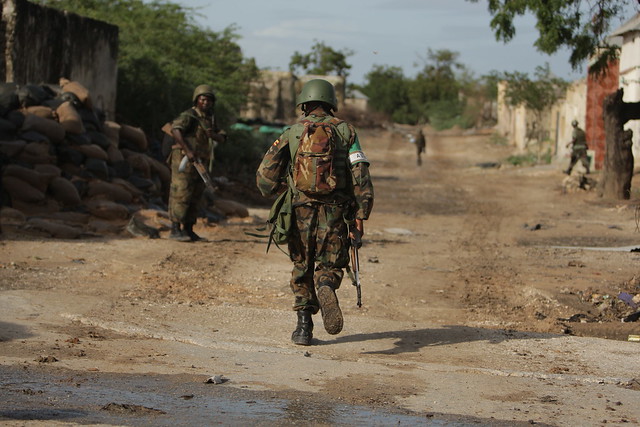
| Ugandan soldiers in Mogadishu from AU/UN flickr |
There has been relative peace in Mogadishu and other areas previously controlled by Al-Shabab. However, this peace is not due to the efforts of the Somali people but rather enforced by the presence of the African Union Mission in Somalia (AMISOM), primarily comprised of Ugandan troops.
Uganda now threatens to withdraw its troops from Somalia due to a UN report detailing its role in arming and supporting rebels in the Democratic Republic of Congo.
This threat worries the Somali government, which entirely relies on the AU peacekeepers for its existence, and the Somali population, who are beginning to believe that peace can return to southern Somalia.
Over the past year, AMISOM has forced Al-Shabab out of most major cities and towns they previously controlled. As a result, Al-Shabab is short on money and recruits, leading to relative peace in Somalia's capital Mogadishu. The peaceful political transition resulting in the creation of a new Somali parliament, the election of a president, and the appointment of a prime minister was made possible by the AU peacekeeping force.
Despite Ugandan President Yoweri Museveni's earlier speeches about his humanitarian intentions in Somalia and his desire for peace (which many doubted), his true motives are now exposed: he uses Somalia as a tool to avoid criticism of his authoritarian rule and his meddling in the DRC. However, it is unlikely that Museveni will actually withdraw his forces due to the UN report, as he benefits politically, militarily, and economically from this intervention.
But what if Ugandan troops leave Somalia prematurely? The consequences for peace in southern Somalia would be devastating. Al-Shabab would likely return to towns like Marka and Afgooye, and possibly even Mogadishu. This would significantly hinder the new government's ability to make any political progress.
The Somali army is largely comprised of militias who were unable to defeat Al-Shabab or maintain peace. Currently, most government soldiers are employed for routine security work at hotels or guarding NGOs and journalists around Mogadishu. Even when fighting alongside the AU peacekeepers, government soldiers often pose the greatest threat to the local population by robbing shops and homes and committing acts of rape.
Somalia's new president stated that creating an effective army is his top priority. However, two months into his term, he has not yet articulated a clear plan to achieve this goal (his predecessors made similar promises but failed). The biggest obstacle is political, as several critical issues need to be addressed before building a unified national army: the relationship between semi-independent regions and the central government, the treatment of warlords and militia leaders who committed major crimes against humanity but currently hold military ranks, and the level of centralization within the army (e.g., will Puntland's army be controlled from Mogadishu?). None of these issues have been addressed so far, meaning the Somali government will likely rely on AU peacekeepers for a long time to come.
Therefore, the most immediate response to the Ugandan threat should be increasing the diversity of troops in Somalia. One proposal, opposed by Uganda, Kenya, and Ethiopia, is to transition the mission from an African Union peacekeeping force to a United Nations force. This would allow more countries, including Muslim nations like Turkey, to contribute troops to Somalia. In the medium term, addressing the political obstacles hindering the creation of a national army is crucial, while simultaneously training a small, multi-regional force that excludes any warlords or militias.


