The beginning of a new year is always promising and full of hope. We spent much of December and beginning of January planning the dreams and aspirations we hope to achieve in the new year. I for one had a very fulfilling 2012 and so my only real goal for 2013 is to try and stay on course.
I was very lucky to have been able to travel to Somalia last year and play a small part in the political changes the country was going through as well as help highlight some of the developmental challenges that still plague many regions. One of the main issues that weighed heavy on my heart, and that I wish to focus on in this brief note, is the haphazardness in the way many people were operating and this is largely due to people meddling in areas that are outside their skill-sets. It sounds very elementary but chaos certainly rises from people trying to do jobs they are not equipped to do. And this is across the board from politics to media, education and humanitarianism, I saw people young and old with lots of enthusiasm and zeal but zero clue of what ought to be done. I sadly also noticed how many people are in it for the wrong reasons, seeking praise and recognition without putting in the hard work. This is an underestimated and overlooked issue that can be costly if it is not addressed.
That being said, I remain inspired by the few that are the exception to the above issue, especially the youth both from the diaspora and within Somalia that put their degrees and professional experience to good use in places where they are really needed. It's these kinds of efforts that need to be sought out, empowered and promoted. The youth really can make the necessary change, if equipped with the right guidance and support as their hearts are often clean from the traumas of clannism.
This is the time where the older generation needs to put their differences aside and come together to inspire the next generation of leaders and in order for that to come to fruition, older generation need to start reflecting on the kind of influence they have on their youngsters and whether this can bring positive changes in the long run.
More than anything,sincerity and a revival of moral conscientiousness needs to take place among all that wish to work towards the rebuilding of Somalia.
May this year be the year she starts to shine.....
Showing posts with label Mogadishu. Show all posts
Showing posts with label Mogadishu. Show all posts
Jan 5, 2013


Dec 4, 2012
Traditional Dance in Mogadishu, Dec 4 2012
Somali women performing traditional dance in Mogadishu Tuesday, Dec 4 2012.
It was the first in three years that this traditional festival, from middle Shabelle, was held in Boondheere district of Mogadishu. Alshabab's strict rules banned such as a festivals and traditional gatherings until they were forced out of Mogadishu by the African Union peacekeepers last year (photography by Feisal Omar).
It was the first in three years that this traditional festival, from middle Shabelle, was held in Boondheere district of Mogadishu. Alshabab's strict rules banned such as a festivals and traditional gatherings until they were forced out of Mogadishu by the African Union peacekeepers last year (photography by Feisal Omar).
 | |
|

 | ||
|

Nov 3, 2012
Somalia's women
 |
| Women meeting the Technical Selection Committee to ensure women are represented |
They didn't get their quota and since then, many presidential candidates including the current president included this issue as a priority into their campaign. I waited to see if any of these discussions and promises would bear fruit and, going by the street talk of Mogadishu in the last few days, the new cabinet, when announced, might be taking a key step into the forward movement of this debate in the form of a female foreign minister.
If this does become true it might be a cause for celebration but what lingers in the back of my mind is the fact that Somali women had always as far back as history depicts been part and parcel of Somali society, unlike our Arab and Western counterparts. They were highly active and held many key posts within government, including ministerial, as well as leading other areas and institutions of the Somali country and society. One of the fond memories I have as a child in Mogadishu is going with my mother to her university, whose department was led by a female professor.
And then when the civil war broke out, women took an even greater social responsibility upon their shoulders and became the backbone of society and initiators of survival. So I wonder when did this backward moving shift occur where women have now got to ask for inclusion, as if they're second
class citizens? Till this day most women are the breadwinners of their households and leaders of their communities but them advocating for a minority inclusion defeats the mountainous role they
always played.
It is a topical issue, one that can certainly not be concluded in a mere blog post but I just wanted to shed light into the need to properly examine and engage with somali women with regards to the roles they played, engage them on an equal platform as men and then look into developing their participation, rather than having minority quotas and the odd ministerial position allocated.
Uganda's threat shows the fragility of peace in Southern Somalia
 |
| Ugandan soldiers in Mogadishu from AU/UN flickr |
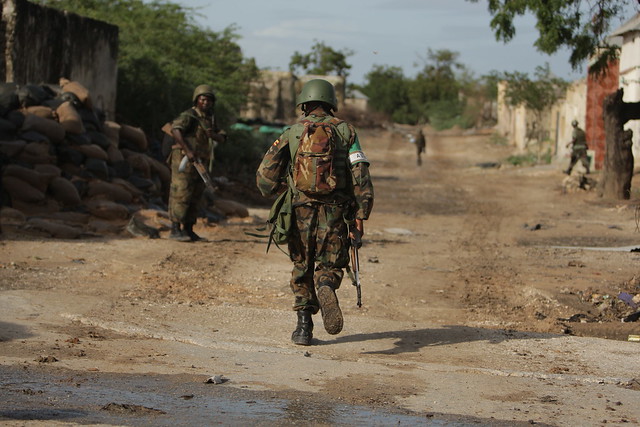
There has been relative peace in Mogadishu and other areas previously controlled by Al-Shabab. However, this peace is not due to the efforts of the Somali people but rather enforced by the presence of the African Union Mission in Somalia (AMISOM), primarily comprised of Ugandan troops.
Uganda now threatens to withdraw its troops from Somalia due to a UN report detailing its role in arming and supporting rebels in the Democratic Republic of Congo.
This threat worries the Somali government, which entirely relies on the AU peacekeepers for its existence, and the Somali population, who are beginning to believe that peace can return to southern Somalia.
Over the past year, AMISOM has forced Al-Shabab out of most major cities and towns they previously controlled. As a result, Al-Shabab is short on money and recruits, leading to relative peace in Somalia's capital Mogadishu. The peaceful political transition resulting in the creation of a new Somali parliament, the election of a president, and the appointment of a prime minister was made possible by the AU peacekeeping force.
Despite Ugandan President Yoweri Museveni's earlier speeches about his humanitarian intentions in Somalia and his desire for peace (which many doubted), his true motives are now exposed: he uses Somalia as a tool to avoid criticism of his authoritarian rule and his meddling in the DRC. However, it is unlikely that Museveni will actually withdraw his forces due to the UN report, as he benefits politically, militarily, and economically from this intervention.
But what if Ugandan troops leave Somalia prematurely? The consequences for peace in southern Somalia would be devastating. Al-Shabab would likely return to towns like Marka and Afgooye, and possibly even Mogadishu. This would significantly hinder the new government's ability to make any political progress.
The Somali army is largely comprised of militias who were unable to defeat Al-Shabab or maintain peace. Currently, most government soldiers are employed for routine security work at hotels or guarding NGOs and journalists around Mogadishu. Even when fighting alongside the AU peacekeepers, government soldiers often pose the greatest threat to the local population by robbing shops and homes and committing acts of rape.
Somalia's new president stated that creating an effective army is his top priority. However, two months into his term, he has not yet articulated a clear plan to achieve this goal (his predecessors made similar promises but failed). The biggest obstacle is political, as several critical issues need to be addressed before building a unified national army: the relationship between semi-independent regions and the central government, the treatment of warlords and militia leaders who committed major crimes against humanity but currently hold military ranks, and the level of centralization within the army (e.g., will Puntland's army be controlled from Mogadishu?). None of these issues have been addressed so far, meaning the Somali government will likely rely on AU peacekeepers for a long time to come.
Therefore, the most immediate response to the Ugandan threat should be increasing the diversity of troops in Somalia. One proposal, opposed by Uganda, Kenya, and Ethiopia, is to transition the mission from an African Union peacekeeping force to a United Nations force. This would allow more countries, including Muslim nations like Turkey, to contribute troops to Somalia. In the medium term, addressing the political obstacles hindering the creation of a national army is crucial, while simultaneously training a small, multi-regional force that excludes any warlords or militias.
Mar 7, 2009
Refugees returning to Mogadishu
Calm has returned to Mogadishu and so have tens of thousands of refugees. They'd fled the two-year long brutal Ethiopian occupation (that's according to Amnesty) and had been living in dire circumstances since. There is no peace yet in Mogadishu but at least there no fighting, for now. The situation is still tense and fighting could brake out any moment but there is also serious talk about peace.
Islamic scholars, from Somalia and outside, are in Mogadishu and have been mediating between the government and the armed opposition. Why Islamic scholars? because both sides are Islamists calling for the implementation of Sharia. Please read Mohamed Adow's excellent explanation of the current situation here.
Islamic scholars, from Somalia and outside, are in Mogadishu and have been mediating between the government and the armed opposition. Why Islamic scholars? because both sides are Islamists calling for the implementation of Sharia. Please read Mohamed Adow's excellent explanation of the current situation here.
Dec 3, 2008
Ambulances For Mogadishu
It is hard to determine which fact is more horrific; the daily unspeakable violence that is still a reality for the millions in Somalia's capital or that Mogadishu is only now getting an ambulance service for the first time in almost 20 years.
Five ambulances may not seem like much, but as the saying unfortunately goes: it is better than nothing. This is a blessing and a good step forward. I only wish it had come from the so-called 'government' rather than the compassion of Irish charity.
Subscribe to:
Posts (Atom)