The best and most renowned guitarist (and musician) in Africa, Ali Farka Toure. For those who haven't heard of him or experience the pleasure of listening to his music, here is a glimpse of his genius. From his Grammy award winning album "In the Heart of the Moon" comes Soumbou Ya Ya (.ra).
Jan 12, 2007


Jan 8, 2007
Interesting links
Nor can we point to Iran on a map: Incoming Democratic chairman of the House Intelligence committee thinks Al-Qaeda is Shia J
100 things we didn't know last year: 100 facts from the news in 2006, check points 5, 45, 27, 23, 35 for example :)
BBC: Housework cuts breast cancer risk: men, you’ve science on your side now.
BBC: Camels' milk could hit UK shelves: Finally, scientifically proven.
Jan 1, 2007
Hajj Mabrur and Eid Mubarak
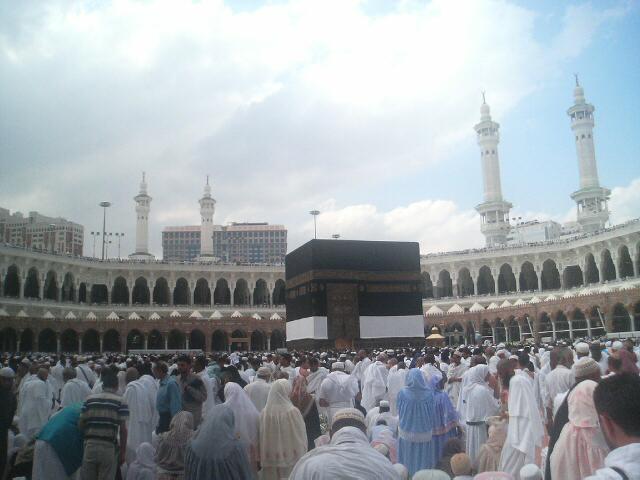 What a dramatic end to an eventful year. I was away from blogging for ten days, and there were some many things happening. The most important and exciting of them, to me at least, is - no, not Somalia or Saddam - the conclusion of the Hajj, without any major incidents and Eid.
(Photo: was sent from Hajj via mobile, by my bro. Moeed)
The Hajj, is the pilgrimage to Mecca and one of the five pillars of Islam. This year, there were over three million pilgrims from around the world. The Hajj is obligatory on every Muslim who is able physically and financially, at least once in their life-time.
In the Hajj, men wear two white sheets, one to cover the upper part of the body and the other for lower part of the body, and no shoes only sandals and open shoes. This is for everyone, so in the Hajj there's absolutely no distinction between people at all. When people die, they're wrapped in white sheets. Women wear hijab but can't cover the face or the hands.
Pilgrims are prohibited to:
- Engage in marital relations
- Shave or cut their nails
- Use cologne or scented oils
- Kill or hunt anything
- Fight or argue
- Women must not cover their faces, even if they would do so in their home country
- Men may not wear clothes with stitching.
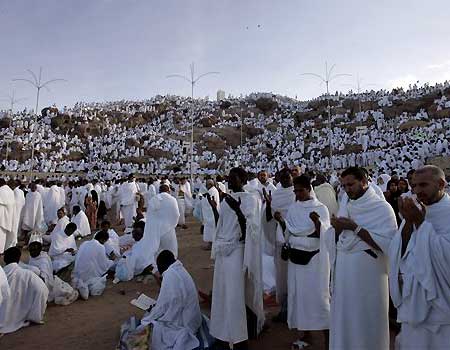
(Photo: pilgrims waiting and praying in Mina, till dawn the next morning before the big day of Arafa).
This is what the pilgrims perform during Hajj (source: BBC, with some alterations:
Day 1: IN MINA
Pilgrims travel to Mina on the 8th of Dhul Hijjah (the twelfth month in the Islamic calendar) and remain there until dawn the next morning. Pilgrims spend their time praying.
DAY 2: STANDING AT ARAFAT
Pilgrims then travel to the valley of Arafat and stand in the open praising Allah and meditating. This is the climax of the Hajj, on this day, Muslims around the world may fast as well. At the end of the day, pilgrims travel to Muzdalifa where they spend the night. Pilgrims gather up stones to use the next day.
DAY 3: STONING THE DEVIL
In the morning, pilgrims return to Mina and throw seven stones called Jamaraat at pillars which represent the devil. The pillars stand at three spots where Satan (shaytan) is believed to have tempted the Prophet Ibraham (Abraham). Pilgrims sacrifice an animal (usually a sheep or goat). This commemorates the incident related in the Quran (and in the Old Testament) when the Prophet Ibraham was about to sacrifice his son Ismail, then Allah accepted a sheep instead. Muslims around the world offer sacrifice as well, and feed the poor. This is the day of Eid Al-Adha for the rest of the Muslims.
Pilgrims shave their heads or cut some hair from it and return to the Great Masjid at Mecca for further Tawaf, walking around the Kaaba seven times. They then return to Mina, where they spend the night.
DAYS 4 & 5
Pilgrims spend time in Mina, stoning the pillars each day. If a pilgrim has been unable to return to Mecca to walk around the Kaaba, he or she does so on the fourth or fifth day. This is called "Tawaf Al-wida", the last Tawaf.
The pilgrimage is physically demanding as it involves walking for miles each day, and only very few hours of sleep, add to it the heat and the extreme overcrowding (with 3 million people, it's an understatement). These harsh conditions, make people edgy but pilgrims aren't even allowed to get angry, let alone react. The Hajj is suppose to test everyone, each person in a unique way. The young and physically able, might struggle to control their emotions while others might have difficulty with the physical demands and the lack of sleep.
One of the main lessons from the Hajj is humility. Regardless of status, color or ethnicity, everyone wears the same simple two white sheets (the sheets people are wrapped in when they die) and perform the same rituals under the same harsh conditions.
The Quran calls the Muslims an "Ummah", meaning one people or one nation. This can be seen in the Hajj, when Muslims from around the world gather in one place, interacting and learning from one another. For centuries, inventions from any part of the Muslims empire - in three continents Africa, Asia and Europe - took only one year to reach the rest of the world, because of the Hajj.
The prize for those who complete all the requirements of the pilgrimage without braking the rules, is complete forgiveness of all their sins - there's no higher prize for a Muslim.
Muslims around the world celebrated Eid Al-Adha in the 10th day of Dul Hijjah (the twelfth month in the Islamic calendar), the 30th of December 2006.
-( Eid Mubarak Everyone )-
Subscribe to:
Posts (Atom)